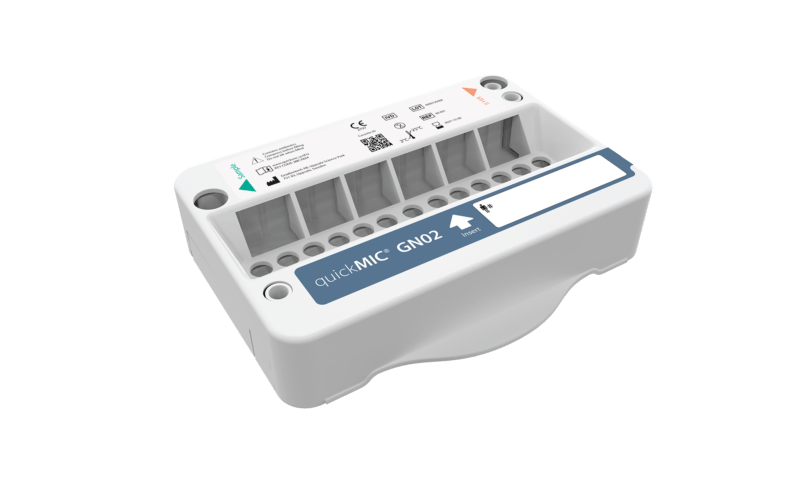
Rapid AST: Speed Is Only Part Of The Story

What happens when rapid AST is challenged with highly resistant Gram-negative bacteria?
As antimicrobial resistance increases, getting susceptibility results faster matters. But speed alone does not determine the value of an AST method. Laboratories also need to consider how many results are available early, how reliably those results agree with reference testing, and how different resistance mechanisms may affect performance.
A 2026 study published in Microbiology Spectrum compared QuickMIC® and EUCAST rapid antimicrobial susceptibility testing (RAST) using a deliberately challenging collection of carbapenem-resistant and/or carbapenemase-producing Gram-negative bacteria.
A challenging test for rapid AST
The study included 101 highly resistant Gram-negative isolates:
- 24 Escherichia coli
- 22 Klebsiella pneumoniae
- 30 Acinetobacter baumannii
- 25 Pseudomonas aeruginosa
All isolates were tested with QuickMIC® and EUCAST RAST directly from spiked positive blood cultures, with broth microdilution used as the reference method. The collection was specifically selected to represent a difficult test population, including a range of carbapenem-resistance mechanisms.
This makes the study particularly relevant when asking a practical question: how do rapid AST methods perform when resistance becomes more complex?
Speed Matters. So does getting a result
QuickMIC® produced results with a mean time to result of 3 hours and 44 minutes across the antibiotics evaluated.
At the four-hour time point:
94.1% of QuickMIC® results were available, while 69.6% of EUCAST RAST results were interpretable.
Early RAST results were more frequently unavailable because zone diameters could not yet be read or fell within the EUCAST area of technical uncertainty. By eight hours, however, the difference in result availability had largely closed.
There is also an important difference in the type of information produced: EUCAST RAST provides categorical interpretations, while QuickMIC® provides quantitative MIC values alongside susceptibility categorisation.
Rapid AST is therefore not only about how quickly a method can run. It is also about when a usable result becomes available and what information that result provides.
Strong performance — with different performance profiles
Despite the highly resistant isolate collection, both rapid AST approaches showed robust overall performance and low very major discrepancy rates.
EUCAST RAST achieved overall categorical agreement ranging from 90.7% to 93.7% across its different readout times, while QuickMIC® achieved an overall categorical agreement of 86.2%. Very major discrepancy rates were low for both methods: 0.1% for RAST and 0.7% for QuickMIC®.
Because QuickMIC® also generates quantitative MIC values, essential agreement with the reference method could be evaluated. This was 92.3% for Enterobacteriaceae and 97.0% for non-fermenters overall.
Performance was not uniform across every antibiotic. Meropenem represented a particular challenge, with lower agreement observed for both methods and a higher minor discrepancy rate for QuickMIC® in Enterobacterales.
That distinction matters. Rapid AST methods should not be understood only through a single headline performance figure, but through how they behave across different antibiotics, organisms and resistance mechanisms.
Resistance mechanisms mattered differently
Whole-genome sequencing allowed the researchers to investigate whether particular antimicrobial resistance genes were associated with AST errors.
The analysis found different patterns between the two methods. NDM-5 was most frequently associated with errors for QuickMIC®, while KPC was most frequently associated with errors for EUCAST RAST.
These findings highlight an important consideration for laboratories working with highly resistant organisms: understanding the performance characteristics of the AST method itself remains important, particularly when results are interpreted alongside complementary molecular resistance testing.
The study authors also emphasise careful interpretation of susceptibility results in carbapenemase-producing organisms, where genotype and phenotype do not always align straightforwardly.

What does the study add?
The study does not suggest that rapid AST can be reduced to a race for the shortest runtime.
Instead, it highlights several factors that become increasingly important in high-resistance settings:
- Speed — how quickly susceptibility information becomes available.
- Result availability — whether a usable result can actually be reported at that early time point.
- Result type — whether the method provides categorical interpretation, quantitative MIC information, or both.
- Method-specific performance — understanding how particular organisms, antibiotics and resistance mechanisms can affect results.
For laboratories managing highly resistant Gram-negative infections, these factors need to be considered together when assessing how an AST method fits into the diagnostic workflow.
The study found that both QuickMIC® and EUCAST RAST generated clinically relevant susceptibility information in a deliberately challenging isolate collection, but with different performance characteristics. QuickMIC® provided quantitative MIC results with a mean time to result of 3 h 44 min, while EUCAST RAST showed different patterns of result availability and categorical agreement across its readout time points.

The bigger picture
The wider message is that no single performance metric tells the whole story. Understanding when results become available, what type of information is reported, and where method-specific limitations occur is an important part of evaluating AST in high-resistance settings.
Degel-Brossmann N, et al. Comparative evaluation of EUCAST RAST and QuickMIC for rapid antimicrobial susceptibility testing of carbapenem-resistant organisms directly from positive blood cultures. Microbiology Spectrum. 2026.